Magalie Mobetie
Mourning Cloud / Will we all end up in the cloud(s) ? - Installation - 2022
présentée dans le cadre de l'exposition Panorama 24 - L'autre coté
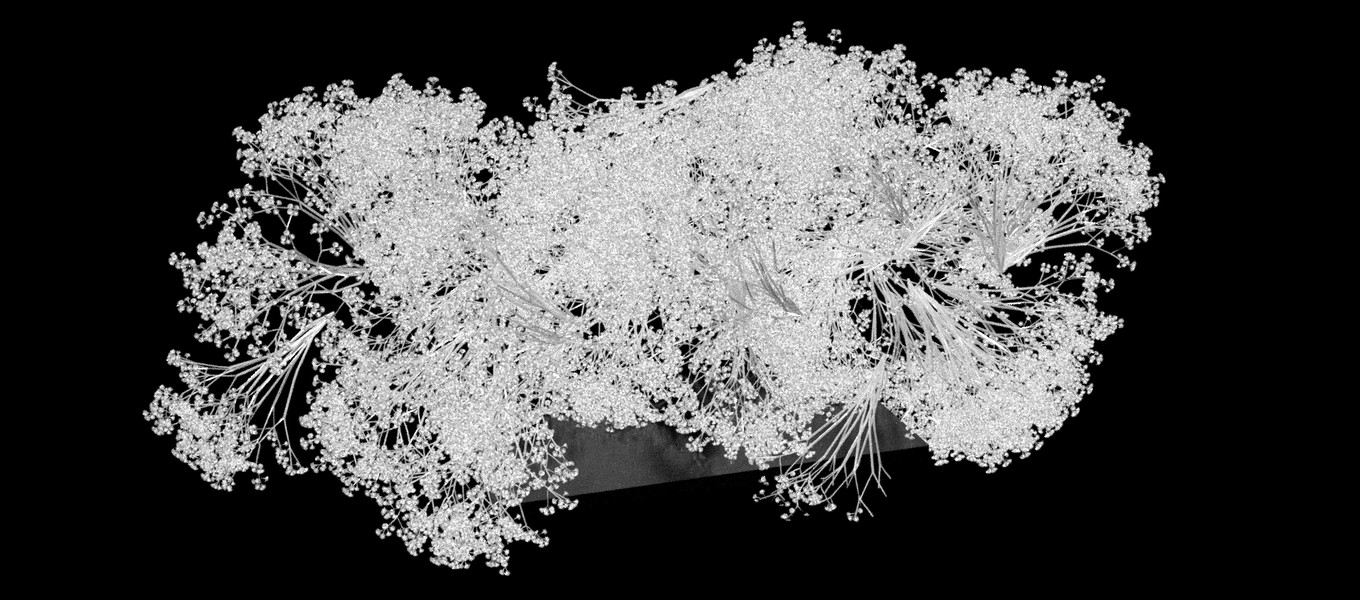


In countries where discussion of anything related to death is extremely awkward, what is the future of physical and digital funerary practices?
The act of listening to a voicemail, looking at photograph and instant messages again and again to is now part of our grieving for a loved one. Services and other spontaneous behaviours have emerged, from personalised VR experience of a farewell to the possibility of attending a funeral via your smartphone.
Mourning Cloud proposes a space where "digital afterlife services" intersect with questions about the ownership of personal data. It allows the visitor to prepare the appearance of his or her own person, using a single piece of data. Freeing himself from his image, processed by a deepfake algorithm disconnected from feelings, his double will remain as long as the Mourning Cloud exists. This encounter between oneself and one's ghost could be a first step towards managing our digital heritage and its attempts to make us immortal.
30 November 1848. Seven months after slavery was abolished in Guadeloupe, Louisonne, Alexandre and their children stood before a registrar in the town of Lamentin in Guadeloupe and were given the name ‘Mobétie’. This administrative record, found by Magalie Mobetie three generations later, has become one of the guiding threads around which her family and her work now weave a link between past, present and future.
A multimedia artist combining visual arts, video, sound, 3D and immersive technologies, Magalie Mobetie is interested in what is left unsaid, unseen and the reasons for silence in families. Trained at Le Fresnoy - National Studio of Contemporary Arts (2020-2022 - Tourcoing, France) and then resident at the Jan van Eyck Academie (2023-2024 - Maastricht, Netherlands), she has developed a transdisciplinary practice in which she assumes the role of ‘future ancestor’, transforming inherited legacies into conscious transmissions.
Since 2023, she has been teaching in the Digital Humanities Master’s programme at the Université Polytechnique des Hauts-de-France. Her approach is part of a critical and exploratory thinking about the diversion of digital tools and extended realities to think beyond entertainment.
